Physical therapy
We use analytics cookies to improve the site. You can accept or decline them. More in our privacy policy.
Rehabilitation after anterior cruciate ligament reconstruction takes months, most often 6 to 12, and goes through three phases. Every recovery is individual, but the phases are the same for everyone. This article is written from experience with hundreds of patients who have been through that process.
Marko Ćurčić, the founder of Fizio Spa, has also worked with elite athletes, among them winners of world and Olympic medals — he was Davor Štefanek’s physiotherapist when he won Olympic gold in Greco-Roman wrestling in Rio de Janeiro in 2016. Work at that level of load is what this approach grew out of.
The ACL (anterior cruciate ligament) is one of the key ligaments of the knee. It gives the joint stability, especially during sudden changes of direction.
The first is comparing yourself with others. People compare themselves with someone who has been through the same operation and put themselves under stress that does not help at all. The second is reading the internet and taking what you read literally. You do not have to be running three months after surgery because someone told you so or because you read somewhere that this is how long it takes.
Before running can be introduced safely, there are specific tests you have to be able to pass. We single running out deliberately — it carries a strong psychological weight. Some say it is the moment when rehabilitation ends and the return to training begins. The truth is that there is no sharp line, and that several people work together on the return to the field: the orthopaedic surgeon, the physiotherapist, the strength and conditioning coach, and sometimes a psychologist.
The first weeks after surgery lay the foundation for everything that follows. The focus is on three things:
In this phase “strengthening” actually means waking the muscle up, because it is precisely its tendon that is most often used to make the new ligament. Patients often say that until then they had no idea what it is like to be unable even to contract a muscle.
What you can do: be patient, tell your physiotherapist about every pain — in this phase we see each other often — and be consistent with your exercises.
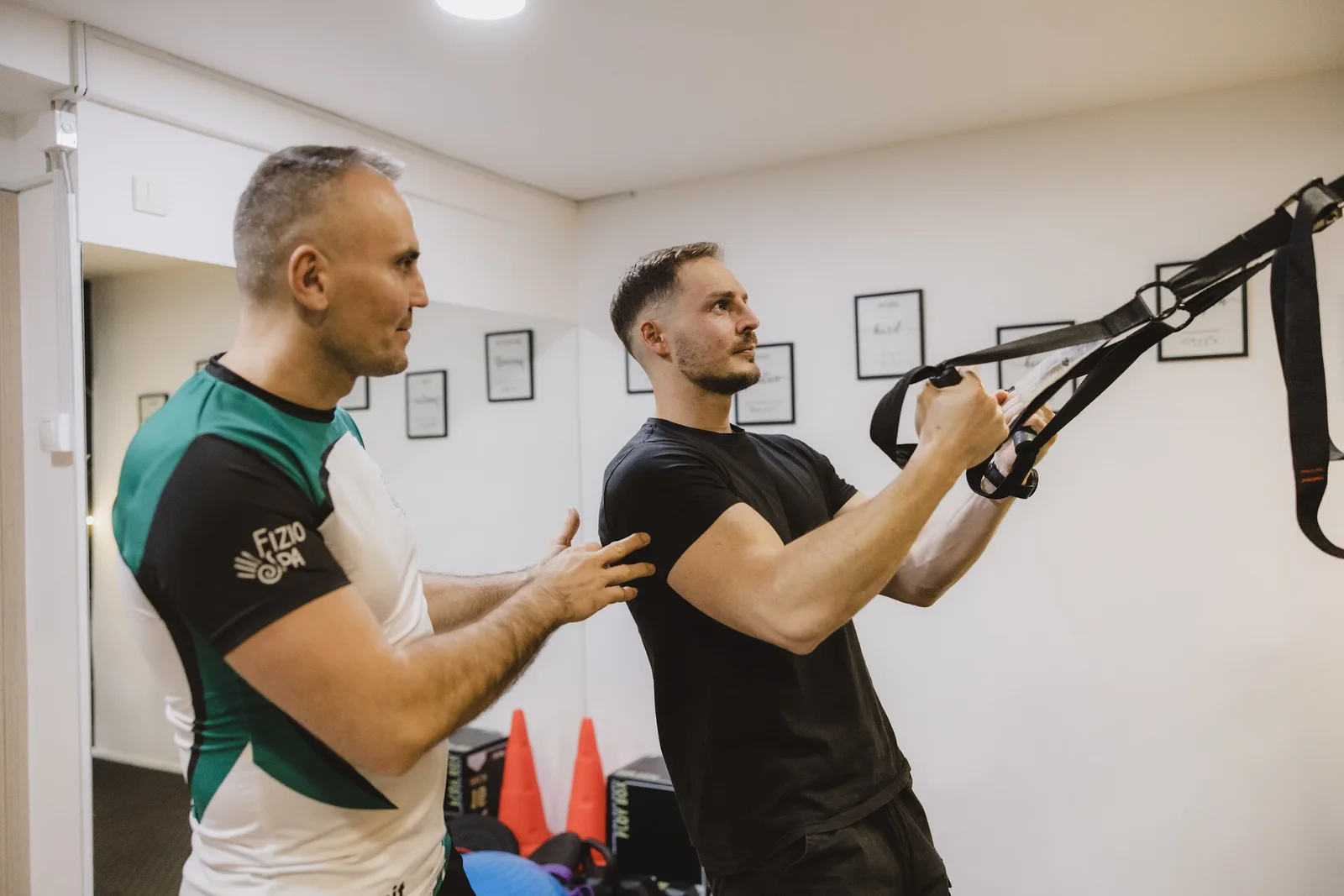
The focus shifts to strengthening all the muscles around the knee, to balance and to proprioception — the awareness of where the body is in space. The following are introduced:
In this phase you can already do a good deal on your own, but the programme should still be guided. Take part in everything your physiotherapist recommends, and ask whenever you are not sure.
Once you are strong and stable enough, you move on to exercises that prepare the return to your sport: simulations of sporting movements, running, jumping, changes of direction and functional exercises.
Here too, patience is the main thing. Returning to sport requires a gradual increase in load, and at this point you are only at the beginning — a good 3 to 6 months are still needed for a full return to the field. The rate of repeat ACL injury is high among athletes who come back too early; the literature reports figures from around 9% to close to 30% in the first year after surgery. That is a reason for taking it step by step, not an excuse.
Listen to your body: if you feel pain, reduce the intensity or take a break. And work with your coach, who should consult the physiotherapist and the surgeon whenever they are not sure how to proceed.
The way the operation is done affects recovery. The arthroscopic method is used most often — minimally invasive, with a faster recovery. The surgeon makes several small incisions around the knee and inserts an arthroscope (a small camera) and instruments.
There are no hundred-per-cent guarantees in medicine. Complications do happen, and they extend an already long recovery. So we come back to the same thing: patience is a skill you have to arm yourself with if you injure your ACL.
Most often 6 to 12 months to a full recovery, plus another 3 to 6 months of gradually increasing load for the return to the field. The exact time is individual.
Not by the calendar, but by tests. There are specific strength and stability tests you need to pass before running can be introduced safely.
For athletes, the literature reports figures from around 9% to close to 30% in the first year after surgery, and the risk is higher in those who return to full load too early.
The new ligament is most often made from the quadriceps or hamstring tendon, so after the procedure the muscle is temporarily “asleep”. Activating it is the first goal of the early phase.
Choose your time online, and you will get a confirmation by email straight away.
Book online