Sports topics
We use analytics cookies to improve the site. You can accept or decline them. More in our privacy policy.
Stretching is most useful when done regularly, calmly and without forcing it: hold each position for 20 to 30 seconds, breathe deeply and feel the pull in the muscle, not pressure in the joint. Ten minutes a day is enough to ease stiffness from sitting and reduce the risk of injury. Below are the exercises Fizio Spa physiotherapists recommend most often.
This article is based on Marko Ćurčić’s guide to full-body stretching. Whether you sit all day, train every day or only get moving at weekends, regular stretching improves posture and mobility.
Stretching is a little uncomfortable, and that is fine. Many people describe it as “a pleasant pain that brings relief”. There is another kind of pain too, the kind that says “wait, something is wrong here”. The rules are simple:
Before training, dynamic stretching is better: controlled swings and movements through the full range of motion, which warm up the muscles. Save static stretching, holding a position for 20 to 30 seconds, for the end of training or a separate evening routine. At first, do not worry about how long you hold; focus on letting the muscle relax.
Side neck bend. Sit or stand upright and slowly lower your ear towards your shoulder. For a stronger stretch, lower the opposite shoulder or gently pull your head with your hand. Hold, then switch sides.
Upper trapezius stretch. Standing, with your hands behind your back, take hold of your right wrist with your left hand and pull it to the left while tilting your head towards your left shoulder. You will feel the stretch on the right side of your neck.
Cross-body shoulder stretch. Bring your straight arm across your chest and press it with your other hand at elbow height.
Chest stretch against a wall. Stand side-on to a wall, rest your palm and forearm against it, then slowly turn your body away from the wall. If you feel the stretch in the shoulder itself rather than in the chest, you have turned too far.
If the pain does not go away, also see our article on neck pain.
Child’s pose. From a position on your hands and knees, lower your hips onto your heels, forehead towards the floor, arms stretched out in front. Spread your knees if you want more of a stretch in the hips.
Lying spinal twist. On your back, bring one knee across your body to the opposite side and turn your head the other way. Breathe deeply. If it is too hard, bring both knees over together. If you have lower back pain or sciatica, check this exercise with a physiotherapist first.
Back stretch on a bar. Hold on to a bar or wall bars and slowly shift part of your weight onto your arms, as if hanging. Avoid this exercise if you have a shoulder injury.
Kneeling lunge (hip flexors). From a half-kneeling position, shift your weight forward, hips forward, until you feel a stretch at the front of the hip of your back leg. For a stronger stretch, take hold of the foot of your back leg and pull it towards your seat. This is the most important stretch for people who sit for long periods.
Butterfly. Sit, bring the soles of your feet together and, with gentle pressure from your palms on your knees, lower them towards the floor. The closer your feet are to your body, the stronger the groin stretch.
Seated glute stretch. Sit with your legs straight, cross one leg over the other so that the foot is next to the knee, then lean forward gently.
Deep squat. With your feet shoulder-width apart, lower into a deep squat with your heels on the floor and gently push your knees outwards with your elbows. If you have knee problems, work on a correct squat first.
Seated hamstring stretch. Sit on your sit bones and lean towards your feet with your spine as straight as possible. Your knees may be slightly bent; over time they will straighten on their own. Variation: lying on your back with your legs resting against a wall.
Calf stretch against a wall. From a lunge, with the toes of your back leg pointing forward, lower the heel of your back leg to the floor. Or stand with the balls of your feet on the edge of a step and slowly lower your heels.
Standing quad stretch. Take hold of your foot behind you and pull it towards your seat, keeping your knees together and your pelvis slightly tucked.
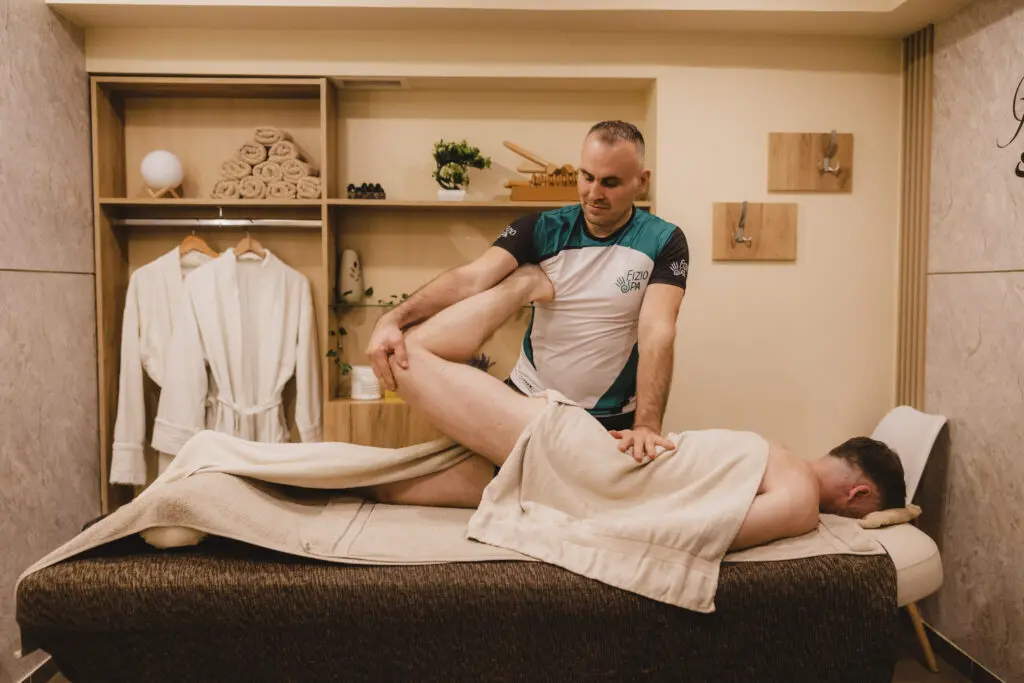
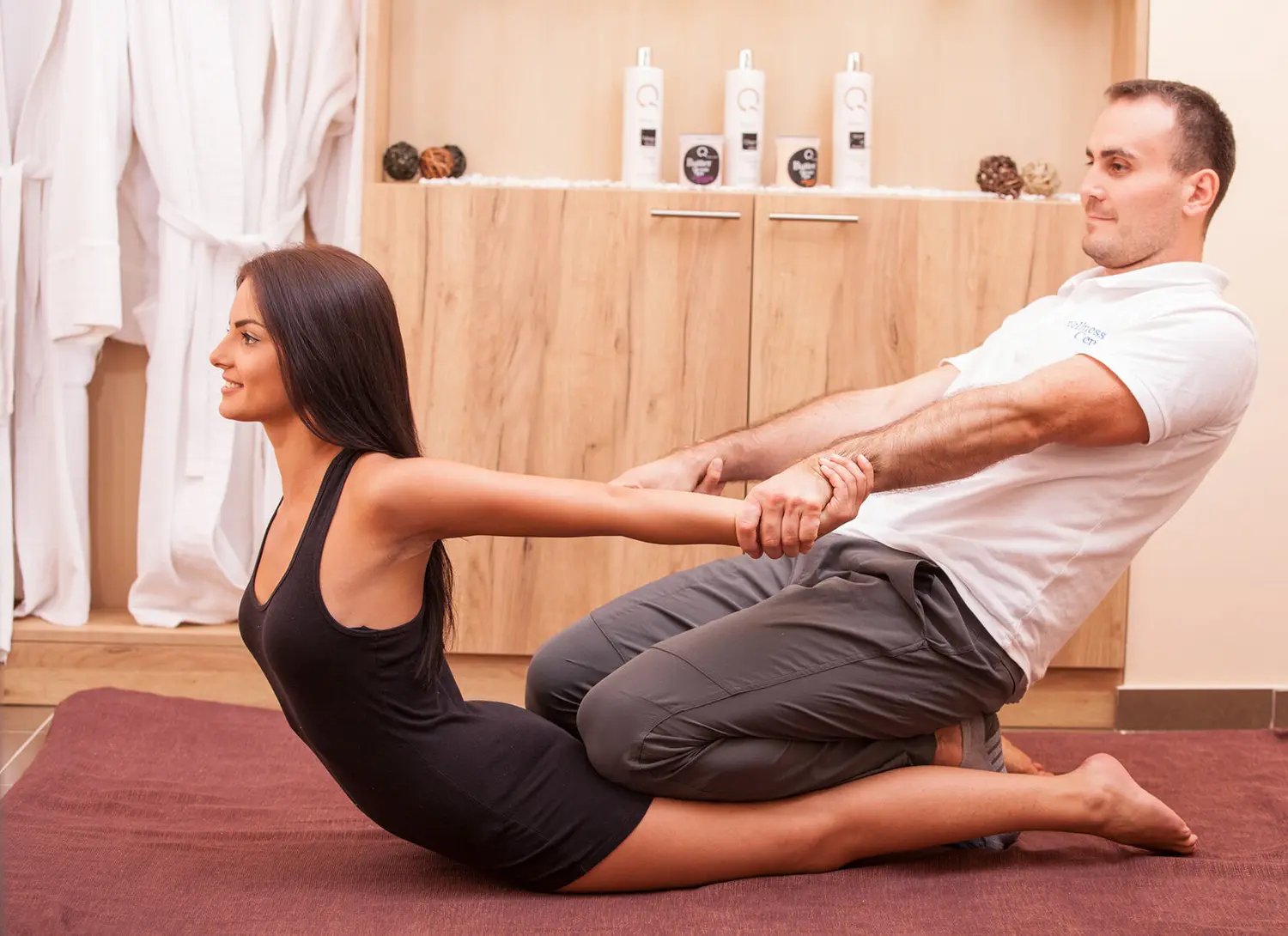
If a stretch keeps causing pain, if stiffness does not ease after a few weeks, or if you have an injury, see a physiotherapist. At Fizio Spa you can add assisted stretching to a treatment, and if you would rather have someone else do the work while you lie down, try a Thai massage.
For static stretching, 20 to 30 seconds per position, with calm, deep breathing. At first, letting the muscle relax matters more than how long you hold.
Before training, do dynamic stretching and a warm-up, and save static stretching for the end of training or a separate routine.
Ideally every day for 10 minutes. Regularity achieves more than an occasional long stretching session.
A mild pull in the muscle is normal. Pressure in the joint, sharp pain, tingling or dizziness are not, and in that case you should stop.
Book a physiotherapy assessment or a massage with assisted stretching online.
Book online